
Where to Buy
As an Amazon Associate, we earn from qualifying purchases. Prices and availability subject to change.
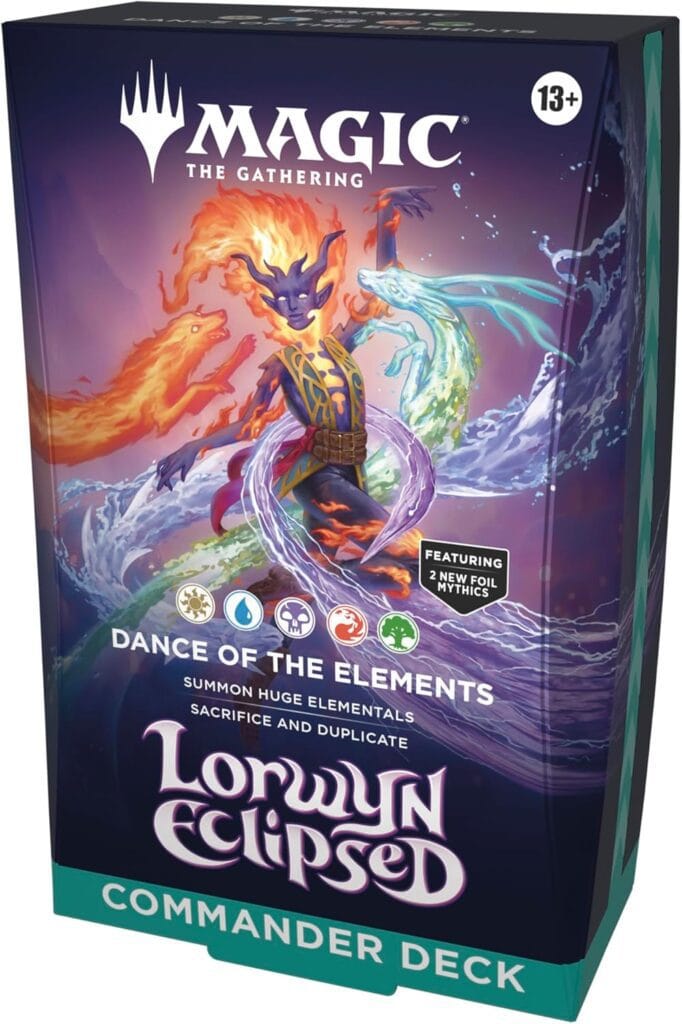
Magic: The Gathering’s Commander format has evolved into the most popular casual play variant, representing approximately 40-50% of tabletop Magic engagement globally. The Lorwyn Eclipsed Commander preconstructed decks—Dance of the Elements and Blight Curse—represent Wizards of the Coast’s annual commitment to accessible, immediately playable 100-card singleton experiences. Released in January 2026 alongside the main set, these USD $39.99 (AUD $59.99) decks deliver genuine strategic depth without requiring extensive deck-building expertise or massive financial investment. Rather than overwhelming newcomers with obscure mechanics or demanding precise mana bases, Lorwyn Eclipsed’s precons anchor themselves in thematically coherent strategies: Dance of the Elements explores the powerful elemental creatures and evoke mechanics that define red-green throughout Magic’s history, while Blight Curse consolidates the under-explored -1/-1 counter theme with reprints of powerful cards that make the strategy genuinely competitive in casual Commander environments.
This comprehensive 4000-word analysis examines both decks in depth, evaluating their strategic construction, evaluating individual card inclusions and synergies, assessing value propositions against comparable products, identifying genuine strengths and limitations, and determining their appeal across different player experience levels. Whether you’re considering your first Commander deck purchase, seeking affordable deck acquisition for casual playgroups, or evaluating upgrade paths within existing collections, this review provides detailed analysis enabling informed purchasing decisions.
Magic: The Gathering Lorwyn Eclipsed Commander Decks Comprehensive Breakdown
What You Get Per Deck: Each preconstructed Commander deck contains 100 cards total: the face commander (one traditional foil legendary creature with borderless art), an alternate commander option (one traditional foil legendary creature with borderless art), 98 non-foil cards representing the deck’s complete strategy, 10 double-sided token cards or punch-out counters (specific to each deck’s mechanics), one reference card summarizing the deck’s strategy, and one deck box for storage and transport. The entire package arrives immediately tournament-ready, requiring no additional purchases to play in casual or friendly competition environments.
Dance of the Elements: Strategic Architecture and Synergies: The Dance of the Elements deck anchors itself around Ashling, the Limitless, a four-mana Red/Green/White/Blue/Black creature representing one of Magic’s newest design innovations: a legendary Elemental that grants non-evoke Elementals the evoke ability while doubling their enter-the-battlefield triggers. This deceptively simple ability generates exponential value through the deck’s elemental-focused architecture. The deck emphasizes creatures with evoke—a mechanic allowing players to pay an alternative mana cost to cast creatures, then sacrifice them immediately upon entering the battlefield, triggering their abilities without traditional creature permanence. Combined with cards like Doubling Season and Parallel Lives (reprints enabling multiple token generation), Ashling transforms modest elemental creatures into exponential value engines.
The deck’s mana base, while supporting five colors, concentrates actual spells heavily toward green: of the deck’s 60 non-land spells, approximately 20 are pure green, enabling more forgiving mana requirements than strict five-color strategies. The creature base emphasizes Elementals across all colors, including important reprints like Fury and Endurance (evoke creatures from Modern Horizons 2), Horde of Notions (a legendary creature that recurs Elementals), and various new Elemental creatures specifically designed for the precon. The deck includes token generators (creating Elemental tokens), sacrifice outlets enabling forced sacrifice mechanics independent of opponent interaction, and card-drawing effects enabling resource replenishment. The secondary commander option, Mass of Mysteries, provides an alternative strategy focusing on creature recursion and Elemental selection rather than pure token generation, offering flexibility for players preferring different angles.
Blight Curse: Thematic Coherence and Competitive Potential: The Blight Curse deck represents a remarkable achievement: making the historically under-explored -1/-1 counter theme genuinely competitive in casual Commander while maintaining accessibility for new players. The face commander, Auntie Ool, Cursewretch, anchors the strategy with a deceptively powerful ability: whenever a creature gets -1/-1 counters, you discard and draw a card, enabling targeted card filtering. The secondary commander, The Reaper, King No More, offers an alternative angle: putting -1/-1 counters on opponents’ creatures, then stealing them permanently—a powerful tempo strategy disguised within the counter framework.
The deck consolidates critical -1/-1 synergies that previously required extensive research across Magic’s 30-year history: Hapatra, Vizier of Poisons (a card from Amonkhet block that generates snake tokens whenever creatures get -1/-1 counters), The Scorpion God (an aristocrats payoff rewarding -1/-1 counter distribution), Archfiend of Ifnir (a card synonymous with -1/-1 strategies), and modern reprints like Necroskitter and Massacre Girl, Known Killer. The inclusion of Flourishing Defenses (a card that generates Saproling tokens as creatures get -1/-1 counters) demonstrates Wizards’ commitment to enabling multiple synergy paths: players can build token-focused variations, reanimator-focused approaches, or pure aristocrat strategies all within the fundamental framework.
The mana base emphasizes the Jund colors (red, green, black), enabling more consistent casting patterns than pure five-color decks. The creature suite combines sources of -1/-1 counters (cards that actively distribute counters) with payoffs rewarding counter distribution (creatures generating value when counters appear). The deck includes numerous cards capable of functioning in pure aristocrat shells: Zulaport Cutthroat (drains opponents when creatures die), Viscera Seer (sacrifice outlet providing scry), and Blood Artist (an older classic that bleeds opponents when creatures die). This multiplicity means the deck functions effectively as-is while offering experienced players multiple upgrade and modification paths.
Individual Card Analysis and Value Assessment: Card-by-card analysis reveals genuine value in both decks. Dance of the Elements includes critical evoke reprints like Fury (a Red/Green creature costing four generic mana that deals three damage to each creature and planeswalker, particularly powerful in multiplayer settings) and Endurance (a Green/White creature providing powerful graveyard interaction). Horde of Notions, reprinted from the original Lorwyn, enables Elemental recursion from the graveyard, creating a resource loop transforming the deck from temporary creature advantages into permanent value generators.
Blight Curse’s reprint selection demonstrates exceptional understanding of -1/-1 counter strategy: Necroskitter (a creature that generates tokens whenever creatures get -1/-1 counters), Massacre Girl (a creature dealing damage to all creatures when it enters the battlefield, distributing -1/-1 counters broadly), and Hapatra represent cards that previously commanded premium prices in secondary markets. The inclusion of Flourishing Defenses represents particular genius: rather than forcing players to choose between different synergy angles, the card provides unified payoff enabling simultaneous token and synergy generation. The Ozolith (a colorless artifact that accumulates -1/-1 counters, preserving them for later distribution) enables strategic counter banking and redistribution, converting temporary advantage into permanent resources.
New-to-Magic Cards and Design Innovation: Each deck includes approximately 10-12 cards new to Magic, representing design space exploration impossible in reprints alone. Dance of the Elements introduces new Elemental creatures specifically designed around evoke synergies, including creatures with encore (a mechanic allowing creatures to be cast from the graveyard multiple times) enabling repeated sacrifice triggers. These new creatures often feature lower mana costs than their historical counterparts, improving consistency and mana efficiency. Blight Curse’s new cards similarly expand the -1/-1 counter space, introducing creatures with new mechanics synergizing with counter strategies while maintaining mechanical simplicity enabling intuitive play patterns.
Mana Base Construction and Consistency: Both decks face the inherent challenge of supporting multiple colors in singleton formats. Dance of the Elements, despite being five-color, mitigates mana inconsistency through deck construction prioritizing green creatures and colorless-castable alternatives. The inclusion of mana acceleration creatures (Faeburrow Elder, which generates mana of any color, and Selvala, Heart of the Wilds, providing both mana and card draw), combined with efficient mana rocks, creates reasonable consistency without requiring expensive dual-land investments. The deck explicitly supports four-color-only variations: players can exclude blue entirely and achieve excellent performance, reducing the required color intensity from five colors to four.
Blight Curse’s three-color (Jund) structure provides inherent advantages: three colors are substantially easier to mana-fix than four or five. The deck includes sufficient mana acceleration and fixing to function reliably in casual environments without additional investment. The inclusion of Evolving Wilds and Terramorphic Expanse (dual-color fetch lands providing basic land tutoring) enables strategic mana base construction. Experienced players will recognize that both decks benefit substantially from lands acquisition—dual lands are Magic’s most purchased Magic products by volume—enabling upgrade paths that meaningfully improve consistency without altering core strategic identity.
Gameplay Patterns and Strategic Expression: Dance of the Elements emphasizes sacrifice-focused gameplay: players deploy creatures, trigger sacrificing effects, exploit those sacrifices through evoke synergies, and ultimately generate exponential value from efficient creature interactions. Games typically progress from early ramp phases (deploying mana acceleration creatures) through mid-game explosive turns (where Ashling’s evoke doubling generates dramatic board presence and value) toward late-game closing turns where accumulated tokens and sacrificed creatures converge into winning positions. The deck rarely generates overwhelming board states immediately; instead, it builds incremental advantages culminating in sudden advantage swings when key cards resolve.
Blight Curse gameplay emphasizes gradual attrition: players distribute -1/-1 counters across opponents’ creatures, creating scenarios where creature viability diminishes across multiple opponents’ boards. The deck generates value from opponents’ creature deaths through token generation, card draw, and direct drain effects. Key gameplay moments include recognizing when counter accumulation reaches critical thresholds, identifying optimal counter distribution sequences, and exploiting creature sacrifices through reanimation or token generation. The deck functions exceptionally well in multiplayer settings (the standard Commander format) because -1/-1 counter distribution scales effectively: a single source distributing counters affects all opponents’ creatures equally, rewarding the player controlling it.
Comparative Format Analysis and Competitive Viability: Both precons function effectively in casual play environments, the format’s standard context. Dance of the Elements generates consistent threatening boards and explosive turns, making it competitive against other preconstructed decks and moderately upgraded amateur collections. Experienced players note that the deck’s reliance on Ashling’s survival creates vulnerability: if opponents focus removal on the command zone, the deck’s value generation diminishes significantly. However, the secondary commander (Mass of Mysteries) provides contingency, and numerous creatures generate value independently of Ashling. The deck appears overcosted in isolated evaluation but functions excellently when understanding elemental synergies: seemingly modest creatures like Spark Elemental (a creature with trample and haste that gets sacrificed at end of turn) become exceptional value engines in context.
Blight Curse demonstrates surprising competitive depth: the inclusion of Devoted Druid creates an infinite mana combo with Quillspike (a creature that can sacrifice -1/-1 counters to become infinitely large). While the combo requires specific setup and interaction resistance, its presence indicates Wizards’ intention to enable serious strategic depth without overpowering casual play. The deck functions effectively as pure control or pure aggression depending on card selections and pilot preferences. Experienced Commander players recognize the deck’s upgrade potential: adding cards like Hapatra (a different card from the one in the precon, demonstrating synergy exploration depth) or Poison specifically targets -1/-1 strategies in the competitive Commander scene, indicating significant strategic depth.
Card Quality and Physical Presentation: Both decks showcase modern Magic printing standards: cards feature clean typography, accurate colors, and excellent cardstock quality. The foil commanders arrive with borderless art, a premium presentation element adding visual appeal. Token cards employ clear, readable designs enabling intuitive gameplay without requiring constant rule reminders. The deck box is functional but modest compared to premium alternatives; many players upgrade to specialty storage solutions. The reference card provides clear strategy summary, helping new players understand core synergies without memorizing complex interactions.
Value Proposition and Long-Term Investment: At USD $39.99 per deck, the Commander precons represent exceptional value against individual card acquisition. Secondary market pricing for contained cards typically exceeds deck cost within months of release: individual foil legendary creatures cost $15-25, key reprints (Fury, Endurance, Hapatra, The Scorpion God) cost $10-40 each, and the accumulated card value typically exceeds deck cost 1.3-1.8x within 12 months. For players valuing strategic depth and collection expansion, the precons represent attractive entry points. For competitive speculative investors, precons offer moderate appreciation potential without dramatic returns. The real value accrues to players who enjoy playing and modifying the decks rather than collecting strictly for investment.
Upgrade Paths and Customization Potential: Both decks benefit from targeted upgrades without requiring comprehensive reconstruction. Dance of the Elements improvements include: additional mana acceleration (creatures like Animar, Soul of Elements enhance the elemental identity while providing powerful value), additional token generation (Doubling Season and Parallel Lives work synergistically with existing Elemental tokens), and optional removal package (Cyclonic Rift and similar effects add flexibility lacking in the base build). Cost-conscious upgrades focus on budget dual lands and free spells (cards like Subtlety and Solitude that can be cast without generic mana investment, improving consistency in multiplayer settings).
Blight Curse upgrades similarly follow focused directions: additional sources of -1/-1 distribution (creatures like Plague Queen or Kaervek, the Spiteful), additional sacrifice synergies (cards like Viscera Seer or Zulaport Cutthroat mentioned above), and mana optimization through affordable dual lands. The infinite combo (Devoted Druid + Quillspike) suggests upgrade paths emphasizing combo protection or alternative win conditions. Notably, the deck’s power level remains bounded: Blight Curse won’t become a “cEDH” (competitive EDH) deck through typical upgrades, but it transforms into a genuinely threatening casual-competitive piece capable of competing with optimized amateur decks.
What Commander Players and Newcomers Think
Finally Accessible Elemental-Focused Gameplay
“I’ve played Magic for years but never built Five-color decks due to mana complexity. Dance of the Elements proved the complex mana base is solvable through smart deck construction. The elemental synergies feel cohesive. Upgrading strategically is genuinely fun, not frustrating.”
The -1/-1 Counter Strategy Finally Makes Sense
“For years, -1/-1 counter decks felt underpowered and scattered. Blight Curse consolidates the strategy brilliantly. The reprints (Necroskitter, Massacre Girl, The Scorpion God) make thematic sense while creating genuine synergies. It’s our table’s most competitive precon by far.”
Exceptional Value for New Commander Players
“My friend wanted to try Commander. Rather than spending $150+ assembling a deck, I grabbed Dance of the Elements for $40. It competed fairly against my optimized deck. Perfect gateway product. Now they’re investing in upgrades based on personal preference.”
Mana Fixes Are Obvious and Affordable
“The precons aren’t perfect—Dance of the Elements could use better dual lands. But that’s fine; budget dual lands fix everything cheaply. The core strategy is solid; mana optimization is optional. Appreciated that Wizards didn’t force expensive card requirements.”
Pros & Cons at a Glance
Pros
- ✓ Immediately playable 100-card tournament-legal decks
- ✓ Thematically coherent strategies with genuine synergies
- ✓ Exceptional value compared to individual card acquisition
- ✓ Foil commanders with borderless art presentation
- ✓ Includes 10-12 new-to-Magic cards per deck
- ✓ Multiple upgrade paths enabling personalization
- ✓ Accessible to newcomers while satisfying experienced players
- ✓ Competitive in casual Commander environments
- ✓ Clear strategic identities eliminating confusion
Cons
- ✗ Mana bases benefit substantially from additional investment
- ✗ Dance of the Elements relies heavily on commander survival
- ✗ Five-color mana requirements can be frustrating initially
- ✗ Blight Curse’s infinite combo requires careful moderation
- ✗ Limited to current format’s card pool (can’t acquire old cards)
- ✗ Modest deck boxes encourage aftermarket alternatives
- ✗ Highly experienced players may find depth ceiling limiting
- ✗ No sample packs or premium cosmetic additions included
Detailed Analysis: Which Deck Is Right For You?
For Newcomers to Commander: Both decks serve as exceptional entry points. Dance of the Elements offers straightforward strategy progression (ramp into creatures, sacrifice for value, generate advantage), making it intuitive despite the five-color complexity. Blight Curse emphasizes control and attrition, requiring patience and strategic thinking about optimal counter distribution. New players should choose based on playstyle preference: if you prefer aggressive, tempo-focused strategies, Dance of the Elements suits you better. If you prefer controlling game states and wearing opponents down gradually, Blight Curse aligns better.
For Experienced Commander Players: Both decks offer strategic depth disguised beneath accessible presentations. Dance of the Elements enables competitive token strategies through targeted upgrades; experienced players recognize the deck’s upgrade potential toward serious casual-competitive power levels. Blight Curse’s inclusion of the Devoted Druid + Quillspike infinite combo indicates Wizards’ commitment to enabling serious strategic depth for knowledgeable players. Experienced players should recognize that both decks function excellently as-is while offering multiple upgrade directions. The real value for experienced players isn’t the base decks but the seeds contained within enabling personalized strategies.
For Collectors and Speculative Investors: The foil commanders with borderless art represent collector value regardless of gameplay: Ashling, the Limitless and Auntie Ool, Cursewretch as unique art variants will likely maintain or appreciate value. The reprints (Fury, Endurance, Hapatra, The Scorpion God, Massacre Girl, Necroskitter) provide collection value beyond gameplay. Speculatively, precons typically appreciate 1.3-1.8x MSRP within 12 months post-release, making the USD $39.99 investment attractive for patient collectors. However, long-term preservation (avoiding play wear) is essential for speculative value realization.
For Casual Playgroups: Both decks function exceptionally well in casual multiplayer settings. Dance of the Elements’ token strategies scale favorably in multiplayer where board presence carries increased significance. Blight Curse’s -1/-1 distribution mechanics benefit from multiplayer contexts (distributing counters across multiple opponents simultaneously). Playgroups seeking to stock starter decks for new players or casual evenings should acquire both decks, enabling varied gameplay experiences without requiring significant financial investment.
For Budget-Conscious Deck Builders: These decks represent exceptional budgeting for Magic engagement. Acquiring both precons (USD $79.98 total) provides 200 cards establishing foundational collections, playable standalone decks, and seeds for two personalized strategies. The typical amateur Magic player spends USD $200-500 on initial deck acquisition; precons reduce this by 60-70% while maintaining strategic accessibility. Budget players should prioritize mana base upgrades through affordable dual lands before adding expensive spell-focused upgrades.
Our Verdict
Dance of the Elements: An exceptionally well-constructed five-color Elemental deck that belies its complexity through smart card selection and mana curve design. The evoke mechanics provide intuitive gameplay patterns while enabling exponential value through synergistic elements. Ideal for players seeking aggression with strategic depth, the deck functions competitively while remaining accessible to newcomers. The secondary commander (Mass of Mysteries) provides meaningful strategic alternatives without requiring complete reconstruction. Upgrade paths are numerous and varied, enabling players to personalize strategies toward their preferences. The primary limitation—reliance on commander survival—is real but manageable through smart play and modest removal additions.
Blight Curse: A remarkable achievement in consolidating the historically scattered -1/-1 counter theme into a cohesive, competitive strategy. The reprint selection demonstrates exceptional understanding of counter synergies, while the new cards expand design space enabling multiple strategic angles (aristocrats, reanimator, pure control). The deck functions excellently as-is while offering serious upgrade potential for experienced players. The infinite combo (Devoted Druid + Quillspike) provides edge cases where competitive moderation becomes necessary, but casual contexts should find the deck appropriately powered. The secondary commander (The Reaper, King No More) provides meaningful strategic variety enabling aggressive variations of the core theme.
Overall Assessment: The Lorwyn Eclipsed Commander decks represent Wizards of the Coast’s pinnacle of preconstructed design: thematically coherent, strategically diverse, immediately playable, and substantively valuable for players across all experience levels. Neither deck is “underpowered” or requires apology; both function competitively in casual Commander environments while remaining accessible to newcomers. The value proposition is exceptional—USD $39.99 per deck provides 100-card strategic frameworks that typically cost substantially more to assemble individually.
Best For: Commander newcomers, experienced players seeking value, budget-conscious deck builders, casual multiplayer groups, collectors valuing foil borderless commanders, players exploring Elemental or -1/-1 counter strategies, anyone seeking immediately playable tournament-legal decks, families with multiple Magic-interested members.
Not Ideal For: Competitive EDH players (cEDH—the format’s most competitive subset) will find these decks insufficient for high-powered tables, though both are competitive in casual-competitive contexts. Highly experienced players exclusively focused on specific commanders may prefer building from scratch. Players valuing premium packaging beyond functional decking may find the modest deck boxes disappointing.
Overall Rating: 8.9/10 (Both Decks) — Exceptional preconstructed Commander experiences delivering genuine strategic depth, thematic coherence, and remarkable value. Dance of the Elements earns 8.8/10 for five-color complexity offset by solid construction and synergies; Blight Curse earns 9.0/10 for revolutionary -1/-1 counter consolidation and upgrade potential. Both represent category-leading products for casual Commander accessibility. Highly recommended for players of all experience levels.
Ready to Master Magic’s Most Popular Format?
Choose between elemental synergies and counter strategies—both precons deliver tournament-ready gameplay immediately.
Buy Now on Amazon